
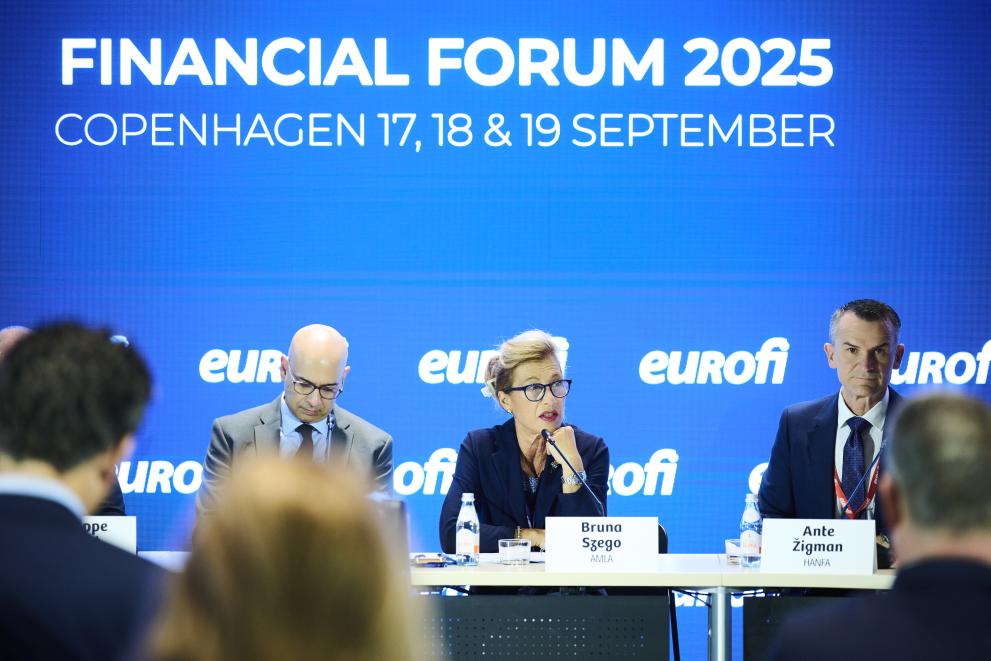
The session brought together public authorities and industry representatives to discuss how to align centralised supervision with national realities and build a future-proof AML framework. Panellists included Andreas Schirk from the Austrian Financial Market Authority, Ante Žigman from the Croatian Financial Services Supervisory Agency, Vojtech Belling from the Czech National Bank, as well as representatives from Western Union, CCF Group and Rabobank.
The discussion focused on defining AMLA's supervisory role and coordinating with national competent authorities to avoid duplication, ensure proportionality, and deliver a realistic transition to central supervision. Panellists also addressed operational and technological challenges, including data standardisation, the use of AI and SupTech, and how AML requirements interact with GDPR and the AI Act.
Ahead of the event, Szego contributed a written piece to the Eurofi publication outlining AMLA's mission and strategic direction. She described AMLA as a new chapter in the EU's fight against financial crime, with a mandate built on three pillars: completing the Single Rulebook, directly supervising high-risk entities from 2028, and coordinating FIUs to strengthen cross-border intelligence sharing.
The Chair set out five long-term objectives guiding the Authority's work: convergence and consistency, cooperation and inclusiveness, technological innovation, institutional trust through transparency, and global leadership. She noted that AMLA had secured its Frankfurt headquarters, formalised partnerships with the European Supervisory Authorities and the ECB, and was on track regarding recruitment efforts.
Szego emphasised that supervision and FIU coordination are deeply interconnected, with both pillars essential to building a comprehensive and effective AML/CFT framework.